Beyond Death: A Visual Journey
The Spiritual Afterlife
What if death is not the end, but the beginning of a much greater journey? For thousands of years human beings have wondered what lies beyond physical life. Religions have offered their answers, mystics have described other states of consciousness, mediums have reported communications from those who have died, and people who have come close to death have returned with extraordinary accounts of continuing awareness.
None of these experiences by themselves provide a complete map of what happens after death. Yet taken together they suggest an intriguing possibility: consciousness may continue when the physical body can no longer support life.
If that is true, death changes completely in meaning.
Instead of being the destruction of the person, it becomes a transition from one state of existence into another.
The Spiritual Afterlife presents a way of looking at this larger journey — not as a single destination called heaven, but as a continuing movement of consciousness through different states, environments and levels of awareness.
Within this wider picture, physical life itself becomes one part of something much greater.
Birth brings consciousness into a particular human experience.
Death releases it from that experience.
What follows may depend upon the nature of consciousness itself, the life just lived, the individual’s state of development, and the much longer journey of the soul.
Leaving the Physical World
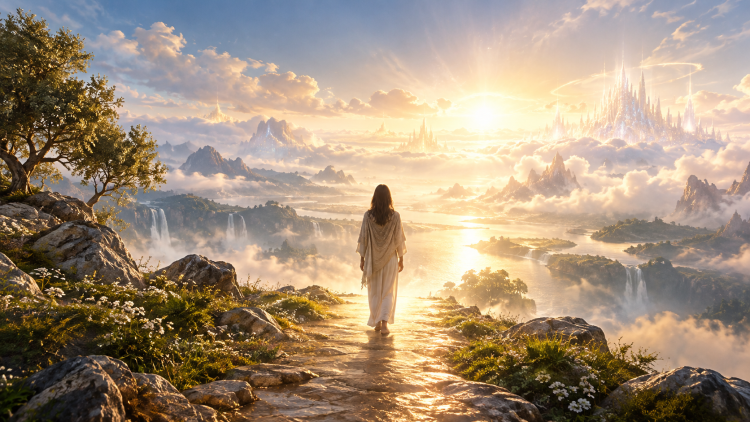
Physical death occurs when the systems supporting the body finally cease to function.
From the conventional material view, consciousness is dependent upon the brain and therefore ends when brain activity ends.
But this is not the only possibility.
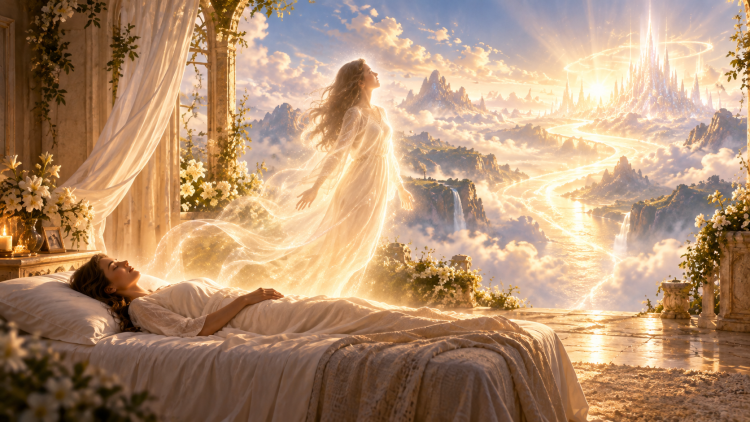
If consciousness is not produced entirely by the brain — if the brain instead acts partly as a receiver, organiser or interface through which consciousness functions in the physical world — then the death of the body need not mean the extinction of the person.
This possibility is particularly interesting because of reports from people who have undergone near-death experiences.
Some describe finding themselves apparently outside the physical body.
They may report seeing the room around them, observing medical activity, hearing conversations or becoming aware of themselves from a completely different perspective.
Others describe little sense of location at all. Instead there may simply be an extraordinary change in awareness.
The heaviness of the physical body disappears.
Pain may vanish.
Thought becomes unusually clear.
There may be a feeling of expansion, freedom or release.
For somebody who has been seriously ill for a long time, the contrast can be particularly dramatic. The physical body may have been weak, confused or in pain, yet the consciousness experienced beyond it is sometimes described as being more vivid and alive than ordinary waking awareness.
This does not mean that everyone necessarily experiences physical death in exactly the same way.
The circumstances of death differ enormously.
Some deaths occur gradually.
Others happen suddenly.
Some people are mentally prepared for death; others are not.
But if consciousness survives, there may come a point at which attention ceases to be centred upon the physical body and begins to function within another order of experience.
The world that seemed completely solid and permanent throughout life begins to recede.
Another reality begins to emerge.
Death, from this perspective, is not annihilation.
It is the laying aside of one form of existence and the awakening into another.
The Transition
Accounts of the period immediately following death vary considerably, yet certain themes appear with remarkable frequency.
People describe light.
They describe profound peace.
They may experience a sensation of movement or expansion.
Some report passing through darkness, a tunnel or an intermediate region before emerging into light.
Others describe the change as almost instantaneous.
One moment they are aware of the physical world; the next they find themselves somewhere entirely different.
Another recurring theme is the presence of other beings.
These may initially appear to be deceased relatives or friends.
For somebody approaching death after a long illness, reports of seeing deceased family members can sometimes begin before physical death itself.
Other experiences involve figures interpreted as guides, helpers, spiritual beings or simply presences radiating extraordinary love and reassurance.
It would be unwise to assume that everybody must encounter the same sequence.
If consciousness continues after death, there is no reason why the transition should necessarily resemble a mechanical process in which everyone passes through identical stages.
The experience may partly reflect the individual.
Expectations could influence perception.
Strong emotional attachments may temporarily hold attention close to physical concerns.
A person who dies peacefully after a lifetime of reflection may experience something very different from somebody whose death is sudden, traumatic or unexpected.
There may also be differences arising from spiritual development.
Someone who has spent many years exploring meditation or altered states of consciousness may already be familiar with the experience of awareness becoming less identified with the physical body.
For such a person, death may involve recognition rather than complete unfamiliarity.
The landscapes may be new, but the movement of consciousness itself may not be.
There may therefore be a period of adjustment.
Some people may understand immediately that they have died.
Others may require time before recognising what has happened.
If consciousness is strongly conditioned by physical life, it is conceivable that familiar surroundings might initially appear around the individual until awareness gradually adapts to its new condition.
The transition should perhaps therefore be thought of less as travelling from one geographical location to another and more as a change in the level at which consciousness is operating.
The physical world fades from immediate perception.
Another level becomes dominant.
The journey continues.
The Realms of the Afterlife
The afterlife need not be one single place.
Many spiritual traditions describe different worlds, planes, levels or realms of existence.
The terminology varies, but the underlying idea is remarkably similar: reality may consist of many different levels, with physical existence representing only one part of a much greater spectrum.
Some of the regions closest to physical experience are described as surprisingly familiar.
There may appear to be landscapes.
There may be buildings, gardens, communities and recognisable forms.
People may meet others whom they knew during physical life.
Communication may appear natural, although it may operate more directly than ordinary speech.
The environment may initially seem almost as substantial as the physical world.
Yet as consciousness moves into subtler levels, the nature of experience may gradually change.
Form becomes less rigid.
Thought and intention become increasingly important.
Communication becomes more immediate.
The distinction between inner thought and outer environment may become less definite.
At still subtler levels, descriptions increasingly involve colour, harmony, light and states of consciousness that become difficult to express in physical language.
The familiar human landscape begins to disappear.
There may be less sense of separate objects occupying fixed positions in space.
Instead there can be a growing experience of interconnectedness.
At the highest levels described by mystics and contemplatives, even the idea of an individual moving through an environment becomes inadequate.
Form may give way almost completely to direct awareness, light, unity or states of consciousness beyond ordinary conceptual thought.
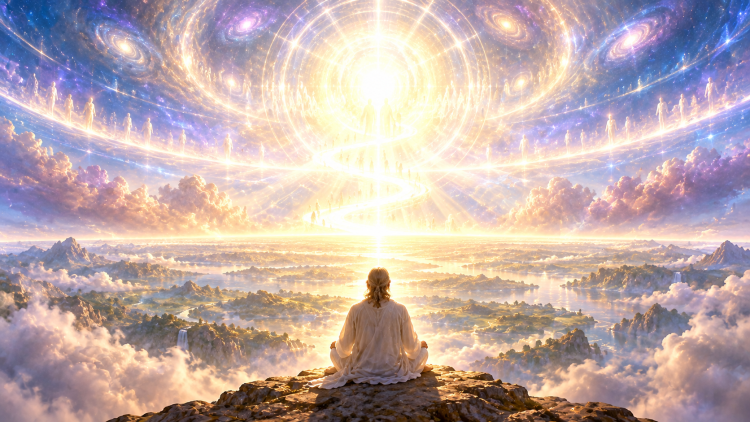
Seen in this way, the word “heaven” may describe not one particular destination but an enormous range of possible experience.
Different states of consciousness may naturally correspond with different levels within that range.
Rather than an external authority simply assigning people to permanent destinations, individuals may gravitate towards environments compatible with their own consciousness.
This could help explain why descriptions of the afterlife vary so greatly.
Different people may simply be describing different regions of a much larger reality.
A person describing a beautiful landscape and another describing an almost formless ocean of light need not necessarily contradict one another.
They may have encountered different levels of the same greater spectrum.
Looking Back at the Life Just Lived
One of the most fascinating features reported in many near-death experiences is the life review.
People sometimes describe important events from their lives returning with extraordinary clarity.
This may occur rapidly, almost as though an entire lifetime can be perceived simultaneously, or it may appear as a sequence of significant episodes.
But the experience is often described as much more than remembering.
The individual may become aware not only of what they did, but of how their actions affected other people.
A careless remark that had long been forgotten may suddenly be experienced from the viewpoint of the person who received it.
An apparently small act of kindness may reveal consequences that continued far beyond anything the individual knew during physical life.
The boundaries between self and others appear less rigid.
We begin to understand ourselves through the effects we had upon the lives around us.
This gives the idea of judgement a very different meaning.
There need be no divine courtroom.
There need be no external figure listing successes and failures.
The deeper judgement may come from understanding.
What did we learn?
Where did we love?
Where did we act from fear?
Where did we help another person?
Where did we cause unnecessary pain?
What opportunities did we recognise?
Which opportunities did we overlook?
What did we understand at the end of life that we could not understand at its beginning?
Such a review need not be punishment.
It may be education at an extraordinary level.
During physical life we usually see events from our own limited viewpoint. Afterwards, if the reports are correct, consciousness may temporarily perceive a much wider network of consequences.
The purpose is not condemnation.
It is growth.
We begin to see ourselves more completely.
We understand both our achievements and our limitations.
And that understanding may become part of whatever comes next.
The Continuing Journey of the Soul
If consciousness survives death, an even larger question immediately appears:
Why do we enter physical life at all?
Why leave subtler levels of existence and enter a world containing uncertainty, limitation, illness, conflict, separation and death?
One possibility is that these very limitations give physical existence its extraordinary value.
In a realm where thought immediately produces experience, certain forms of learning may be comparatively easy.
Physical life is different.
Here there is resistance.
Actions have consequences.
Other people have independent desires.
The future is uncertain.
We forget whatever may have preceded our birth.
We must make choices without seeing the complete picture.
Relationships become intensely important because we experience ourselves as separate individuals.
Love matters because separation seems real.
Compassion matters because suffering is possible.
Courage matters because fear is possible.
Forgiveness matters because injury is possible.
Patience matters because we cannot instantly obtain everything we want.
Physical existence may therefore provide an unusually concentrated environment for development.
The difficulties of life are not necessarily evidence that life has gone wrong.
They may be part of the reason a world such as this exists.
From this viewpoint, one human lifetime would rarely be sufficient for the full development of consciousness.
Different lives could provide radically different perspectives.
We might experience wealth and poverty.
Strength and vulnerability.
Leadership and dependence.
Parenthood and childhood.
Health and illness.
Achievement and failure.
Belonging and isolation.
Each condition reveals something different.
This provides a framework within which reincarnation begins to make sense.
Rebirth need not be understood as punishment for previous behaviour.
It may instead be part of a much larger educational process.
There may be further experiences to encounter.
Relationships to resolve.
Qualities to develop.
Consequences to understand.
And possibilities that could only arise through returning to physical existence.
This does not mean that every detail of every lifetime is predetermined.
A meaningful life requires genuine choice.
There may be broad circumstances, tendencies or relationships associated with a particular incarnation while enormous freedom remains in how the individual responds to them.
Life, death and rebirth could therefore form part of a much larger evolutionary journey of consciousness.
The personality changes.
The circumstances change.
The body changes.
But something deeper continues.
Beyond the Cycle
Yet perhaps even reincarnation is not the final purpose.
If consciousness simply moved through an endless sequence of lives, accumulating experiences indefinitely, the process would have no ultimate direction.
The deeper spiritual traditions suggest something more profound.
Eventually the journey turns inward.
Instead of merely experiencing the world, consciousness begins to question the nature of the experiencer.
Who am I?
What is awareness?
What lies behind thought?
What remains when ordinary identity becomes quiet?
Is consciousness something created within each separate individual, or are individual minds expressions of something much greater?
This is the territory of spiritual awakening.
During the early stages, there may be glimpses.
A profound stillness.
An unexpected inner light.
A temporary disappearance of ordinary thought.
A sense that the boundaries of the individual are less absolute than previously believed.
As spiritual development continues, such experiences may deepen.
The person no longer merely believes that there is a greater reality.
They begin to experience it directly.
The sense of being an isolated consciousness existing inside a separate body gradually becomes less convincing.
Something deeper begins to reveal itself.
The spiritual journey then changes direction.
Instead of asking only, “What happens to me after I die?” another question becomes increasingly important:
“What is the ‘me’ that dies?”
At the highest stages described by contemplative traditions, the distinction between individual consciousness and the greater reality becomes increasingly transparent.
The person may discover that what appeared to be a completely separate self was always contained within something vastly greater.
Words such as Source, Absolute, God, Universal Consciousness or Pure Awareness have been used in different traditions to point towards this reality.
The words are not the experience.
They are attempts to describe what may ultimately lie beyond language.
Seen from this perspective, the journey of the soul is not merely a movement through places.
It is a movement towards recognition.
Consciousness travels through experiences, relationships, worlds and perhaps many lifetimes, gradually discovering its own deeper nature.
The journey that appeared to carry us outward ultimately leads inward.
And the consciousness that seemed to be searching for the Source discovers that it was never entirely separate from it.
Death, therefore, is neither the end of existence nor the ultimate destination.
It is one doorway within an extraordinary journey.
In Essence
● Death may represent a transition of consciousness rather than its extinction.
● The experience immediately following death may differ according to the individual, their awareness and the circumstances of transition.
● The afterlife may contain many different levels or realms, ranging from environments resembling physical existence to increasingly subtle states of light and consciousness.
● Reflection upon the life just lived may reveal the consequences of our actions and provide understanding rather than judgement.
● Reincarnation may form part of a continuing process through which consciousness experiences, learns and develops.
● Spiritual awakening may ultimately lead beyond the repeating cycle of physical lives towards recognition of the deeper source of consciousness itself.
Explore the Journey in Greater Depth
This page offers an overview of an enormous subject.
The Spiritual Afterlife explores each stage of the journey in much greater depth — what may happen during death itself, the transition beyond the physical world, the different levels of the afterlife, reunion with those who have died, the life review, reincarnation, the nature of the soul, spiritual awakening and what may eventually lie beyond the cycle of repeated physical lives.
It also examines near-death experiences, communications from beyond, unusual experiences surrounding death, ancient spiritual teachings and modern attempts to understand the relationship between consciousness and the physical brain.
No single account can provide every answer.
But by bringing together experience, spiritual insight, reason and open enquiry, a remarkable possibility emerges.
Our physical lifetime may be far more important than we realise — but it may also be only one chapter.
The larger story may concern the continuing development of consciousness itself.
And death may not close that story.
It may simply turn the page.
Click for the next page: Communications
