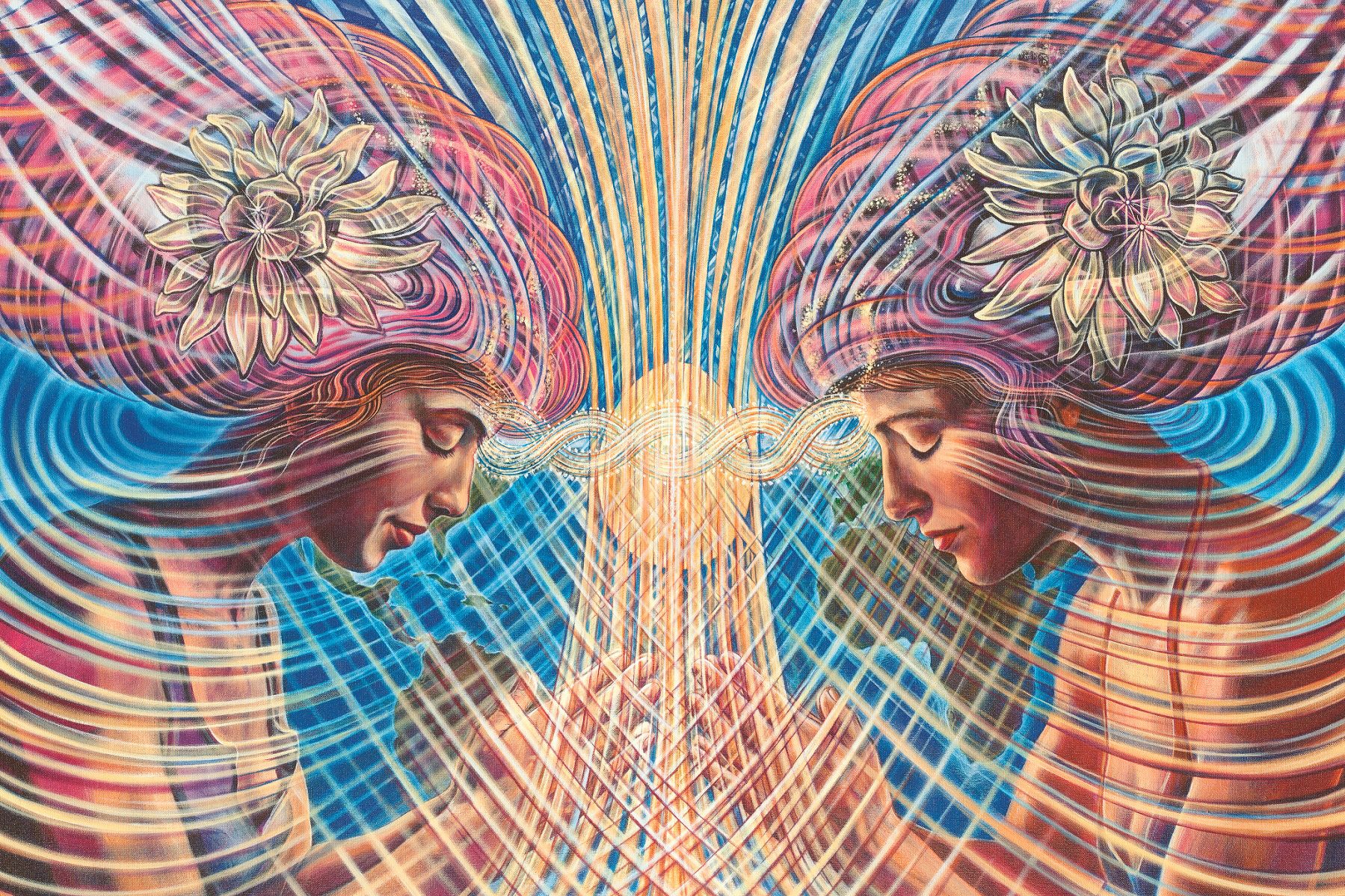
If we gather together the deepest strands of human testimony — near-death experiences, mystical insight, deathbed observations, profound meditation, spiritual communications, regression accounts, and the recurring intuitions of contemplative traditions — a broad and surprisingly coherent picture begins to emerge. It suggests that physical death may be not the end of consciousness, but the beginning of another stage in a much greater journey.
This is not presented as a complete map.
It is not beyond revision.
Nor should every testimony be treated as equally reliable.
But when many different forms of experience are considered together, certain patterns recur often enough to deserve serious attention. What follows may therefore be regarded as a working model: perhaps one of the best models we can offer at this time.
The first and most fundamental suggestion is simple.
We survive.
Death appears to mark the end of the physical body’s role as the principal vehicle through which consciousness operates. Yet awareness itself does not necessarily disappear with it. In many accounts, consciousness continues with a meaningful degree of identity, memory, feeling, recognition, and perception.
The person who awakens beyond death does not usually describe having been erased.
They describe having crossed.
The Afterlife as a Continuum
The afterlife, within this model, is not a single place.
It is better understood as a continuum of consciousness — a spectrum containing different levels, regions, or states of experience. Some appear relatively close to ordinary human awareness. Others seem increasingly subtle, luminous, expansive, and difficult to describe in earthly language.
In the earlier stages after death, many accounts describe environments that remain recognisable.
There may be landscapes, gardens, buildings, colours, animals, familiar people, or forms resembling the physical world. Individuals may experience themselves as having a body, although this is no longer a physical body in the ordinary sense.
Loved ones may be encountered. Helpers or guiding presences may appear. Communication can seem unusually direct. The surrounding environment may feel more fluid and more immediately responsive to consciousness than anything experienced during physical life.
This leads to one of the central ideas in the model: consciousness and environment may be much more closely related beyond death than they appear to be here.
What we encounter may depend not only upon where we are, but upon what we are.
Our inner state may matter profoundly.
Love, fear, attachment, openness, confusion, compassion, rigidity, humility, expectation, and spiritual maturity may all influence the conditions into which consciousness naturally moves.
This is why the word resonance may be particularly useful.
Rather than imagining the afterlife as a crude external system of reward and punishment, a deeper view suggests that consciousness may gravitate towards conditions compatible with its own state.
One is drawn by affinity.
The soul encounters what it can presently recognise, inhabit, and understand.
This does not necessarily imply permanent separation into fixed levels. The condition of consciousness may itself change, allowing movement into wider and subtler realities.
Help, Guidance and Life Review
The idea of resonance does not suggest that individuals are simply abandoned to whatever limitations they carry beyond death.
Quite the opposite.
One of the most reassuring themes within near-death testimony, deathbed experience, mystical accounts, and spiritual communication is the recurring presence of help.
This assistance may be experienced as deceased relatives, loving companions, spiritual guides, beings of light, advanced intelligences, or simply an unmistakable presence of compassion and understanding.
The language varies.
The underlying principle is remarkably consistent.
Death does not appear to be entered entirely alone.
There may be a period of orientation, recovery, recognition, and adjustment. Those who die suddenly or in confusion may require particular help. Others may move through the transition with extraordinary ease.
The Communications section of this website explores some accounts that appear to offer glimpses into this continuing process.
Another frequently reported feature is some form of life review.
This need not resemble a judgment imposed by an external authority. In many accounts, it is closer to an intensified experience of truth.
A person may become aware not only of what they did, but of how their actions affected others. Moments of kindness may be experienced from the recipient’s perspective. Harm may similarly be understood with a clarity that was unavailable during earthly life.
The central question may therefore be less, “Were you good or bad?” and more:
What did you understand?
What did you give?
What did you learn?
Where did you love?
Where did fear prevent love?
What possibilities did you accept, and which did you avoid?
Seen in this way, the life review is not primarily punishment.
It is revelation.
It may be consciousness seeing itself without the ordinary defences of personality.

The Journey Into Higher Realms
The model becomes more profound as the journey continues.
Beyond the more familiar and human-like conditions described close to earthly existence, many accounts suggest increasingly subtle levels of consciousness.
Personal identity may gradually become less rigid.
Earthly biography remains meaningful, but it may no longer define the whole being. What we ordinarily call personality may begin to appear as one temporary expression of something much deeper.
Communication may become less dependent upon speech.
Understanding may become immediate.
Love may cease to be experienced merely as an emotion between separate individuals and begin to reveal itself as something more fundamental — almost an organising quality of reality itself.
Descriptions of these higher states vary enormously.
Some speak of vast landscapes of light.
Others describe radiant structures, extraordinary colours, patterns, music, geometry, or realms of immense beauty.
Some contemplatives report states beyond recognisable form altogether: brilliant darkness, profound silence, boundless awareness, or a presence that seems more real than ordinary existence.
Earthly language begins to fail at this point because our language evolved to describe a physical world of separate objects.
Higher states may not be organised in quite that way.
The further consciousness appears to move from ordinary physical awareness, the less the afterlife resembles an improved version of Earth and the more it appears to reveal an underlying spiritual reality.
Eventually the journey raises an even deeper question.
Does the soul remain an entirely separate individual forever?
Many profound spiritual experiences suggest something subtler.
The separate self may be real at one level while not being ultimate.
As consciousness moves into deeper states, the distinction between the individual and the greater Reality from which consciousness arises may gradually become less absolute.
The soul is not necessarily destroyed.
It may instead discover a larger identity.
Thus the afterlife may not be only survival.
It may also be return.
We begin with the discovery that death has not ended us.
We may eventually discover that we were always more than the individual self we believed ourselves to be.
For a wider exploration of awakening to these deeper states during physical life, the Links page provides pathways into related material.
A Simple Working Model
The broad journey can therefore be expressed in a simple sequence:
● The physical body dies, but consciousness continues.
● There is an initial continuity of identity, awareness, memory, and relationship.
● Consciousness encounters conditions that may partly reflect its own inner state or resonance.
● Help, guidance, recognition, and orientation are available.
● A deeper understanding or review of earthly life may occur.
● Consciousness may continue through increasingly subtle realms or states.
● Personal identity may gradually become less restrictive as the deeper nature of the soul emerges.
● Beyond even the higher spiritual realms, consciousness may be drawn towards reunion with the greater Reality from which it came.
This sequence should not be imagined as a rigid staircase through which everyone must pass in exactly the same manner.
Consciousness may be far more fluid than that.
Some stages may overlap. Some may be bypassed. Some experiences may occur almost instantaneously from an earthly perspective, while others may involve what appears to be a long process.
Our ordinary understanding of time itself may not fully apply.
The purpose of the model is therefore not to imprison the mystery within a diagram.
It is to give the mind enough structure to begin exploring it.
Important Cautions
Any serious exploration of the afterlife requires humility.
● No single near-death experience should be regarded as the complete map of existence beyond death. It may describe only the threshold.
● A communication from someone who has died may reflect one particular state or realm rather than the whole spiritual continuum.
● Mystical experience can sometimes appear to move directly into very high states and may therefore reveal little about intermediate conditions.
● Regression material may contain meaningful insights while also being influenced by memory, imagination, expectation, or interpretation.
● Different genuine experiences need not contradict one another simply because their descriptions differ. They may concern different levels of the same much larger reality.
This is why the model offered here remains deliberately open.
The Questions & Answers section considers many of these uncertainties individually and explores some of the difficulties involved in interpreting spiritual experience.
Where evidence is suggestive, it should be described as suggestive.
Where we are making an inference, we should recognise it as an inference.
And where mystery remains, mystery should be allowed to remain.
There is another important implication.
If consciousness continues through resonance, then how we live now may matter profoundly.
Death may not automatically produce wisdom where wisdom has not begun to develop.
It may not instantly dissolve every attachment.
Nor would it erase compassion, understanding, stillness, or spiritual depth that have genuinely become part of us.
Earthly life may therefore be preparation for continuity.
Not preparation for an examination.
Preparation through becoming.

What Matters Most
If this model contains even part of the truth, then spiritual development need not be understood as something remote from ordinary life.
It takes place through the qualities of consciousness we cultivate every day.
● Love matters.
● Clarity matters.
● Compassion matters.
● Attachment matters.
● Humility matters.
● Inner stillness matters.
● Sincerity matters.
The small movements of consciousness may be more significant than we realise.
Learning to forgive.
Becoming less governed by fear.
Seeing another person’s point of view.
Developing greater awareness.
Learning to become still.
Allowing love to become less possessive and more inclusive.
Questioning the assumptions of the personality.
Seeking truth because it is true rather than because it confirms what we already believe.
These may not simply be moral virtues.
They may gradually change the state of consciousness itself.
The final reassurance within this model is that reality appears, in many of the deepest accounts, to be far more compassionate and intelligent than human fear tends to imagine.
Death may involve confusion for some, but not abandonment.
It may involve truth, but not arbitrary condemnation.
It may require letting go, but not extinction.
It may involve purification, but not meaningless punishment.
Beneath the changing forms of the journey there appears repeatedly the suggestion of guidance, intelligence, compassion, and movement towards greater understanding.
A Closing Reflection
So what happens after death?
Perhaps the most balanced answer available at present is this:
Death appears to be a transition in consciousness rather than its end.
The individual continues, at least initially, within a subtler reality. There may be recognition, relationship, guidance, healing, and a gradual understanding of the life just completed.
Consciousness may then move through states increasingly removed from ordinary physical existence, discovering levels of itself that were largely hidden during earthly life.
Eventually the journey may lead beyond the familiar personality altogether and towards the deeper Source from which individual consciousness arose.
That model cannot yet be proved as one proves an equation in physics.
Nor should it be imposed upon anyone.
But it gathers together a remarkable range of human experience into a coherent possibility.
And perhaps it can be expressed even more simply.
We do not fall into nothing.
We pass out of density.
At first, we still know ourselves.
Then we begin to discover that we were always more than the self we knew.
And beyond the worlds of familiar form and memory there may be something vast, luminous, and profoundly intimate — not a foreign destination, but the deepest home consciousness has always carried within itself.
In Essence
● Death may be a transition in consciousness rather than the extinction of consciousness.
● The afterlife may consist of a continuum of states or realms, with consciousness naturally moving according to resonance and inner development.
● Guidance, loving assistance, and some form of life review appear repeatedly within serious accounts of the transition beyond death.
● The journey may continue from relatively familiar post-death states into increasingly subtle and profound levels of awareness.
● The ultimate movement may be not merely survival of the individual personality, but the gradual discovery of a deeper identity and eventual return towards Source.
● If consciousness continues, then the qualities we cultivate during physical life may become part of what we carry forward.
This is offered not as a final doctrine, but as a working model — a framework within which experience, testimony, spiritual insight, and further enquiry can be considered together.
The mystery remains immense. Yet the possibility that emerges is not one of disappearance, but of continuation, discovery, and return.
Click for the next page: A Visual Journey
