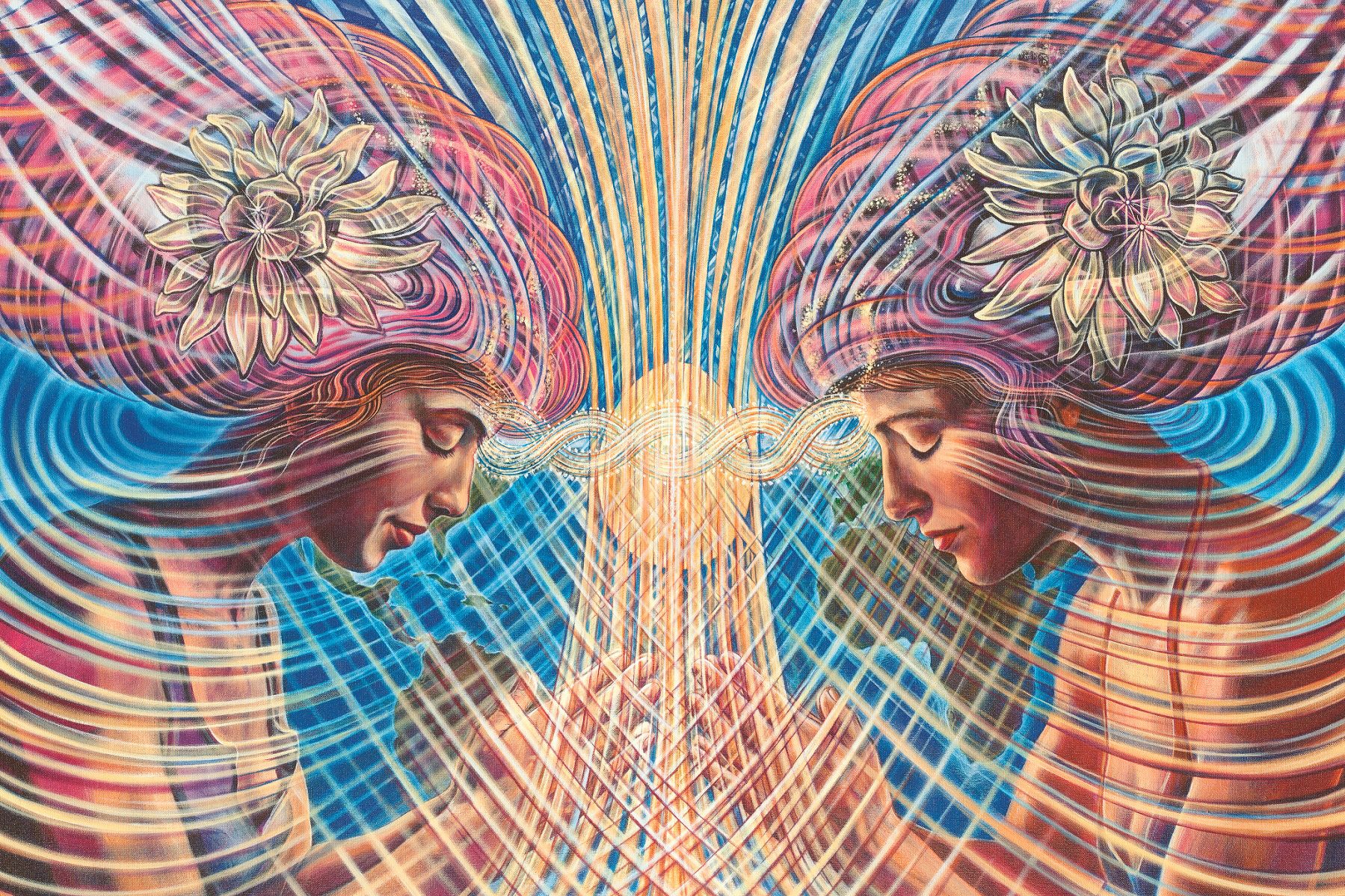
When the moment of death arrives, the deepest view is that consciousness does not simply end. What ends is the soul’s connection with the physical body. The body falls away, but awareness itself continues.
The First Separation
At death, the physical vehicle can no longer hold the life force. The consciousness that was operating through the body begins to withdraw from it. For many people, this may happen quite gently. There can be a sense of loosening, release, or detachment, as though one is stepping out of a garment that has served its purpose.
In many accounts, the person still feels present, still aware, and often still very much themselves. They may not immediately realise that death has occurred, especially if the passing was sudden or peaceful.
Awareness Continues
What survives is not the physical brain, but the deeper consciousness that was using the brain as an instrument. This is why so many spiritual traditions, near-death experiences, and after-death communications suggest that death is a transition rather than an extinction.
The personality may still remain for a time. Thoughts, feelings, memories, recognitions, and attachments can all still be present. In that sense, the individual often continues into the next phase with a familiar sense of identity.
The Transition State
For many souls, the first stage after death appears to be a transitional realm that feels understandable and reassuring. People may encounter familiar surroundings, loved ones, helpers, or beings who assist them in adjusting to the new state.
This is one reason why so many descriptions of the early afterlife still sound quite human. The soul often enters a realm that reflects what it is ready to experience and understand.
What Determines the Experience?
The immediate experience after death seems to depend greatly on the person’s state of consciousness.
● Those strongly identified with earthly life may enter a world that resembles earthly life in important ways.
● Those with spiritual understanding may move more quickly into subtler and higher states.
● Those who have cultivated inner awareness through meditation, prayer, surrender, or love may find the transition clearer, lighter, and more conscious.
In simple terms, people often go to what they already know, or to what they are inwardly prepared to receive.
Death Is Not the End
From this perspective, death is not a fall into nothingness. It is a movement from one level of experience to another. The outer shell is left behind, but the journey of the soul continues.
This does not mean that every soul immediately enters the highest spiritual reality. For most, there are stages, adjustments, insights, and further unfoldings. But the essential point remains: something real continues.
The Deeper Spiritual View
At the deepest level, death can be seen as a release from limitation. The soul is no longer confined to the dense physical body and begins to experience itself more directly in subtler dimensions of existence.
For the ordinary person, this may mean entering a heavenly state or a realm of learning and recovery.
For the more spiritually advanced, death may be a more conscious passage through inner realms already known in meditation.
For the enlightened, even these intermediate stages may be transcended, because their identity is no longer rooted in personality or form, but in the Eternal.
In Essence
What happens at the moment of death is not annihilation, but transition.
● The body is left behind
● Consciousness continues
● Identity often remains at first
● The soul enters a state that reflects its level of awareness
● The journey goes on
So the moment of death is best understood not as a full stop, but as a doorway.