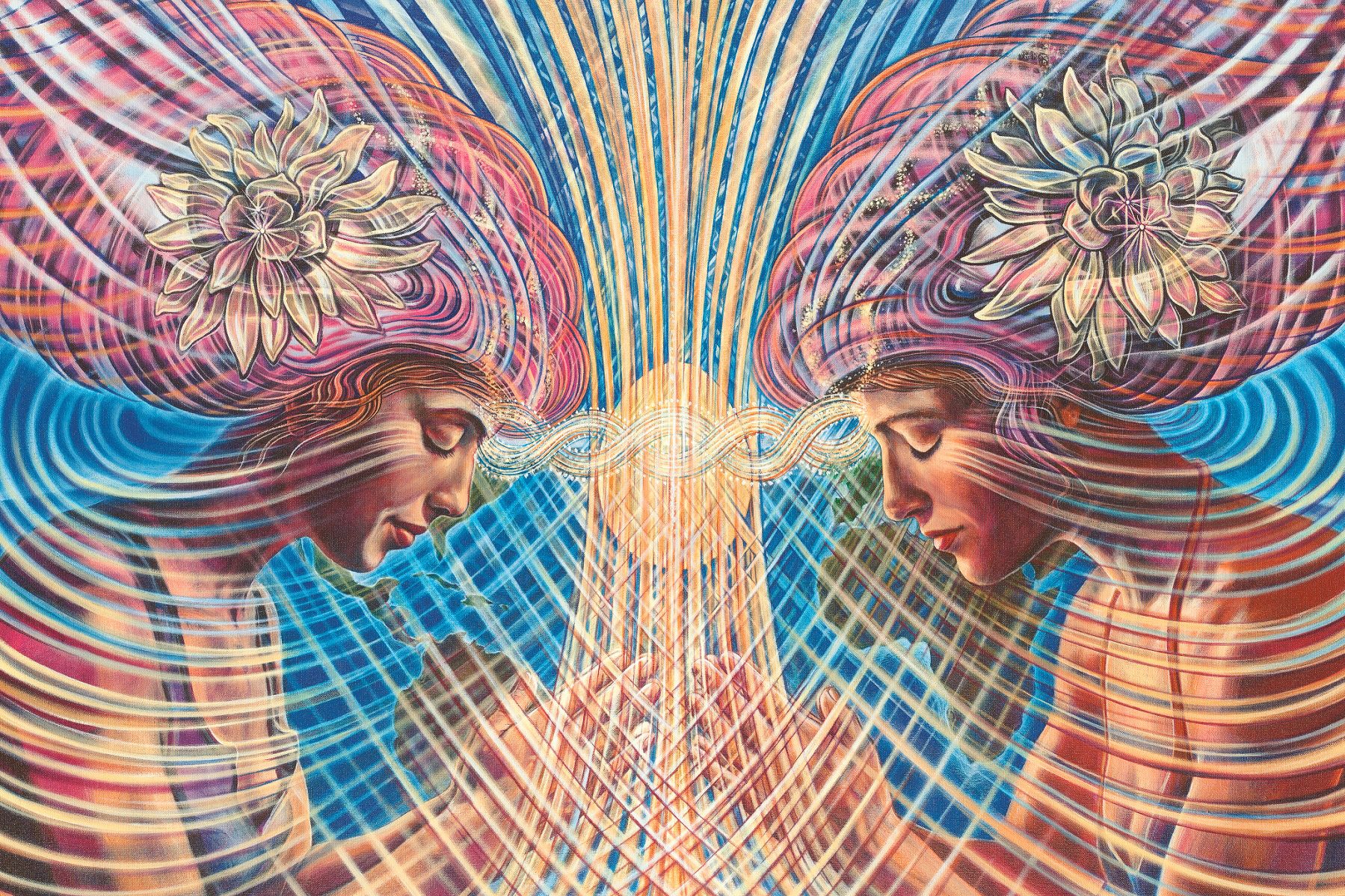
This is the first of two articles synthesising the testimonies of a small group of experienced meditators who took part in the Journey of the Soul project, an enquiry intended to glimpse possible aspects of the soul’s transition beyond physical death. Rather than reproducing each testimony in full, the accounts have been brought together to reveal the recurring themes and correspondences that appeared across a number of different meditations. The experiences varied considerably, yet several striking patterns emerged.
Moving Beyond the Physical Body
One of the clearest themes was a gradual reduction in the ordinary sense of physical identity.
In one meditation, a stream of white Light was seen moving upwards through the chakras and eventually beyond the crown of the head. The accompanying understanding was that this might represent the way in which the soul leaves the physical body at death.
Other experiences involved the body disappearing from awareness altogether. There could be a sense of floating, expansion, stillness or simply being present without any clear physical boundary.
In another deep meditation, awareness entered an illuminated space in which there seemed to be no distinction between the observer and the Light itself. The body was no longer apparent and there was instead a sense of being within something much larger, without obvious boundaries.
A deeper view suggests that the transition beyond physical life may involve a progressive loosening of identification with the body. The meditator does not necessarily experience a dramatic departure, but rather a movement into a state in which physical identity becomes less central and consciousness itself becomes more apparent.
Being Carried by Light, Sound or Mantra
Several of the accounts contained a distinct sense of movement.
This was not usually experienced as physical travel from one geographical place to another. It was more often described as being drawn, carried or transported into another state of awareness.
In one particularly clear meditation, the mantra seemed to become a living current. Rather than simply being repeated, it appeared to carry the meditator onwards through Light towards a realm that felt deeply familiar. Other beings were sensed there, together with recognition, acceptance and love.
In another account, inner Sound became so powerful that the mantra faded almost immediately. Awareness seemed to float upon a column or current of Sound, moving deeper into stillness before an all-pervading brightness appeared.
A further vision may provide another way of understanding this movement. A beautiful sea appeared containing perhaps ten or fifteen waves, all bathed in exquisite silvery moonlight. The waves were remarkably regular, almost perfectly evenly spaced and of very similar height. Considerable white foam appeared along their crests and between them, yet there was no obvious turbulence sufficient to explain it.
What was particularly striking was the degree of order.
Ordinary sea waves usually vary in height, spacing and form. In this vision, however, the waves appeared almost patterned, as though they were revealing a repeated underlying rhythm.
One possibility is that the image was simply an unusually beautiful seascape. But another interpretation is that the waves may have represented something more fundamental: the cyclic or rhythmic movement of energy.
Waves are one of the most universal ways in which energy is expressed and transferred. Light, sound and many physical systems involve oscillation, frequency and repeating cycles. If subtler forms of energy or consciousness also possess rhythmic organisation, such a process might perhaps be perceived through the familiar image of waves.
The almost perfect spacing may therefore be significant. Rather than representing turbulence, the vision may have been showing an ordered sequence: pulses, cycles or oscillations moving through a deeper field.
The silvery illumination is also interesting. Moonlight does not create ocean waves; it reveals their form. In a similar symbolic sense, consciousness may have been becoming aware of an underlying energetic pattern that is normally present but unseen.
This interpretation remains speculative, but it fits intriguingly with the repeated appearance throughout the project of currents, waves, vibration, Light, Sound and ordered structures.
These experiences suggest that transition may not simply involve a soul deliberately travelling somewhere. Consciousness may instead become receptive to currents or patterns that naturally carry it from one state into another.
Within deep meditation, Light, Sound and mantra may therefore be more than objects of attention. They may be experienced as pathways or vehicles through which awareness moves beyond its ordinary limits.
Light as a Realm of Consciousness
Light appeared repeatedly throughout the Journey of the Soul project, although its character differed considerably between meditators.
Sometimes it appeared as golden specks, brilliant white illumination or a vast golden field. At other times it possessed unusual qualities, including the appearance of liquid gold.
More significant, perhaps, were those occasions when the distinction between the Light and the person experiencing it began to disappear.
One meditator described an illuminated space with no identifiable source of Light. The brightness was simply everywhere. There was no awareness of where the Light began or ended, and the meditator felt both within it and part of it. The physical body and its normal boundaries had disappeared from awareness.
Another experience presented a great golden Light surrounding a dark sphere representing the physical world. Individual conscious beings were perceived as openings through which the greater Light of Consciousness could shine into that world.
Although the imagery differed, the underlying suggestion was similar. Consciousness might not merely encounter Light as something external. At deeper levels, the distinction between Light and consciousness may become increasingly difficult to maintain.
Perhaps the Light encountered in such states is not simply something that consciousness sees, but something within which consciousness discovers its own deeper nature.
Geometry and Ordered Structures
One of the more unexpected correspondences within the reports was the repeated appearance of geometry.
In one meditation, a vast arrangement of complex golden structures appeared against a jet-black background. The forms were three-dimensional and architectural, like intricate frameworks constructed from golden lines. They appeared beautiful, ordered and unlike familiar physical objects.
Elsewhere, another meditator found herself amongst transparent geometric forms, with shapes above, below and all around. There was also the unusual recognition that she herself was somehow part of this geometry. The whole experience resembled moving through a galaxy of geometrical structures and points of Light.
Another report contained a geometric form resembling the view down a stairwell, accompanied by the sensation of being pushed inward and moved by something like an ocean wave.
It would be premature to decide exactly what such geometries represent.
They may be symbolic constructions arising within consciousness. They may reflect energetic or subtle structures. Or they may be glimpses of aspects of reality for which ordinary physical perception provides no adequate language.
What makes them especially interesting is that geometrical forms appeared independently in several accounts.
The regular moonlit waves may also belong within this wider theme of order. Geometry describes pattern and relationship in space, while waves express pattern through movement and time.
A deeper view suggests that subtler levels of consciousness may not be formless or chaotic. They may possess organisation, relationship and pattern, even if these are perceived in forms very different from ordinary physical objects.
What appears to the meditator as golden geometry, transparent structures or perfectly repeated waves may therefore be the nearest visual equivalent of something fundamentally energetic, vibrational or conscious in nature.
Disintegration and Transformation
The golden geometries contained another important feature.
They did not seem simply to be static structures suspended against the darkness. There was also an impression that some form of disintegration was taking place, as though an existing organisation was gradually breaking down.
This changes the possible meaning of the experience.
Rather than merely revealing the architecture of another level of reality, the vision may have been showing a process: structure changing, dissolving or being transformed.
One state of organisation may have been breaking down so that another could emerge.
This possibility is especially relevant to an enquiry into the journey beyond physical death. Death itself involves the ending of one highly organised physical structure through which consciousness has expressed itself. If consciousness continues, perhaps transition involves changes in subtler forms of organisation as well.
The golden forms against the profound blackness could therefore represent a threshold between states. Existing structure appears to be dissolving, yet this need not imply destruction in the absolute sense. Disintegration may instead be part of transformation.
Nature repeatedly shows this principle.
Forms arise, remain for a time, change and eventually dissolve. Yet the energy and constituent elements do not simply cease to exist. They participate in further forms.
Something similar may perhaps occur within consciousness.
The black background is intriguing in this respect. It need not represent emptiness or non-existence. It may simply have been the nearest visual representation of an unknown or unmanifest condition beyond the structures that were changing.
Seen this way, the golden geometries and the moonlit waves may reveal complementary aspects of the same process.
The geometry suggests organisation.
The disintegration suggests transformation.
The waves suggest continuing movement and cyclic energy.
Together they raise the possibility that the Journey of the Soul involves not simply travelling from one location to another, but a progressive transformation in the structures and patterns through which consciousness expresses itself.
Life Review, Memory and Previous Incarnations
Another important theme concerned the past.
One meditator experienced a succession of scenes from her own life, beginning in childhood and continuing into adulthood. The images appeared one after another and then drifted away. There was no judgement, drama or particular emphasis on one event over another. The experience carried the clear sense of observing and learning from the life that had been lived.
Another meditation repeatedly brought forward people and relationships from the past. This raised the possibility that the transition beyond physical life may involve an encounter with the relationships, attachments and unresolved elements still held within consciousness.
There was also an experience in which one face changed into another and then another. The meditator immediately understood that previous incarnations were being shown. On another occasion, children from a school attended more than fifty-five years earlier appeared, accompanied by an immediate recognition that the experience concerned life review.
Taken together, these accounts suggest that movement beyond physical identity may involve not only travelling towards something new, but also encountering what has already been accumulated within consciousness.
Death, from this perspective, may not instantly remove memory, relationship or the consequences of experience. Some process of review, understanding or assimilation may form part of the soul’s continuing journey.
Such a process need not necessarily involve judgement. Several of the reports instead suggest observation, recognition and learning.
Familiarity, Peace and the Sense of Returning
Perhaps the most reassuring feature of the testimonies was their emotional character.
Despite exploring death and transition, the dominant qualities were not fear, darkness or isolation. Again and again there appeared peace, stillness, familiarity, beauty and a sense of being supported.
One meditation revealed a peaceful country road winding gently through familiar countryside. The accompanying understanding was that a newly transitioned soul might sometimes encounter surroundings that feel reassuring and recognisable, allowing awareness to adjust gradually to its changed condition.
Another meditator found herself looking across an ocean, knowing that she was about to undertake a journey in a small wooden boat. The scene was accompanied by profound peace and a sense of returning to something familiar, almost like coming home.
Elsewhere, a higher realm containing other beings felt neither strange nor threatening. Instead there was recognition, acceptance and love, together with the feeling that the realm was already known.
The imagery varied greatly: a road, an ocean, waves, Light, geometry, beings and Sound.
Yet beneath these different forms there repeatedly appeared a similar quality. Transition was experienced as something supported rather than abandoned, and entered through peace rather than fear.
This does not imply that every soul must have the same experience. It may instead suggest that the transition is adapted to the consciousness and readiness of the individual.
No Single Map of the Afterlife
The Journey of the Soul reports do not produce a single, fixed description of what happens after death.
Nor should they necessarily be expected to.
If consciousness continues beyond the physical body, its experience may vary according to the individual, their level of awareness, their attachments, their familiarity with inner states and perhaps the particular stage of transition being encountered.
A peaceful earthly landscape, a field of regular moonlit waves and golden structures undergoing transformation need not contradict one another.
They may represent different levels, different functions or different ways in which consciousness interprets what it encounters.
What becomes interesting is therefore not whether every meditator saw exactly the same thing, but whether apparently independent accounts contain recurring principles.
Across the testimonies several such principles can be recognised: loosening from physical identity, movement or transition, Light and Sound, currents and waves, geometric organisation, disintegration and transformation, review of the life just lived, continuing awareness, the presence of other beings, and a pervasive sense of peace.
There is also a deeper possibility emerging from the reports: that consciousness beyond the ordinary physical state may reveal itself through pattern and transformation.
● Light has frequency.
● Sound has frequency.
● Waves move cyclically.
● Geometry expresses ordered relationships.
● Structures can form, change and dissolve.
● Currents carry energy.
Perhaps these apparently different experiences are not entirely separate phenomena. They may be different perceptual expressions of an underlying reality in which consciousness, energy, vibration, organisation and transformation are intimately connected.
The reports remain testimonies rather than proof. Nevertheless, when experienced meditators independently approach the same enquiry and repeatedly encounter related themes, those correspondences deserve careful consideration.
Perhaps what emerges is not a map of a single afterlife world, but a glimpse of a process: consciousness gradually releasing its identification with physical existence, passing through transformations of structure and awareness, and awakening to progressively wider dimensions of itself.
In Essence
● The meditation reports frequently involved a diminishing awareness of the physical body and an expansion into a wider field of consciousness.
● Light, Sound and mantra were sometimes experienced not merely as objects of meditation, but as currents capable of carrying awareness into deeper states.
● The vision of remarkably regular moonlit waves raises the possibility that energy or consciousness may sometimes be perceived as cyclic, rhythmic or oscillatory in nature.
● Geometric forms appeared independently in several accounts, suggesting that subtler states of consciousness may possess organisation and structure.
● The apparent disintegration of the golden geometries raises the further possibility that transition involves not simply movement, but transformation from one form of organisation into another.
● Taken together, the testimonies suggest not a single fixed afterlife landscape, but a dynamic process involving Light, Sound, energy, pattern, transformation and progressively changing states of consciousness.
These experiences cannot by themselves establish exactly what occurs after physical death. They do, however, offer a thoughtful and unusually coherent body of testimony. When approached without either blind belief or automatic dismissal, they invite a deeper possibility: that death may be less an ending of consciousness than a transformation of its mode of expression — a journey through changing patterns of Light, Sound, energy, structure and awareness that deep meditation can sometimes begin to reveal.